
I was just re-listening the audio-book version of “Atomic Habits” by James Clear.
It made me to think about numerous students and people here on this wonderful Community.
Yes; you are often on my mind! 
I found out about this book several years ago and from time to time it pops up in professional trainings I follow. Reason enough to give it another go. While the autor goes quite deep in some methods, a lot of value is there to be read or listened to as free podcast on Spotify.
Early in the book, the author explains how it is more important to do a certain activity a lot, rather than doing it a larger total amount of time, in order for it to become a habit
That is very relevant to people when it comes to learning a new technique or lead part. I found out is is especially true when practicing timing and strongly time-related skills like finger-picking and strumming. I believe this is also true for developing muscle memory and something I often refer to as ‘your auto pilot’.
What is this “auto-pilot”?
What is this “auto-pilot”?

I wanted to show this cartoon as “auto-pilot’ might sound as a negative property, but in this case I emphasize the positive quality: it is about being able to delegate a task to your subconcious self so you have more (processor)time to to do something in parallel, at the same time.
Stacking on the Auto-Pilot
Want to learn to fingerpick, change chords, keep rhythm AND sing?
That’s 4 things at once!
My advice: start with one skill and train it enough, you can do it with your eyes closed and automatically while speaking, watching a tv show etc. Then you can start to stack other things on top
This applies to a lot of things, like Keeping a rhythm strumming, fingerpicking a pattern, changing chords… The more you are on auto-pilot, the less resources of your brain-computer it will use and the more real-time resources you have left for other synchronous tasks.
I encounter people who have difficulty singing while they still struggle with rhythm or a picking/strumming pattern. That makes perfect sense as you need to develop enough auto-pilot in one part first in order to build upon it. more on that later.
More session is better than longer sessions
I believe that doing as much sessions as possible is the key.
I rather have you practicing 5 minutes on a picking pattern every day than an hour on Sunday.
I’m also convinced that sleeping is helping here; each session followed by a quality night of sleep will solidify the neuron pattern, layer over layer. Like painting layers and layers of laquer on top of each other or smithing more and more layers of steel on top of each other to create a strong sword.
James Clear also explains in his book that tests have shown that, to develop a durable habit, it is more important have a high quantity of an activity rather than to have a long total time of doing the activity. Don’t get it wrong though, your 5th practice session of the day will probably add little to your fatigued brain.
Doing it a lot will help you do it automatically…it becomes a habit
So make sure it’s a GOOD habit!
The more you do it, the more automaticity, so the graph below tells us.
At a certain moment in time, the automaticity is so high, the activity becomes a habit.
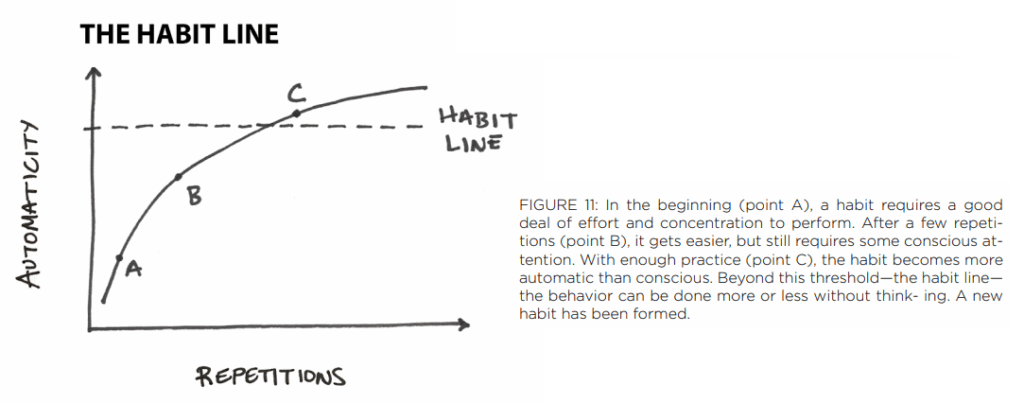
Apply that principle in your practice schedule. If you have an amount of hours to spend each week on guitar; try to spread it over as many days as you can. Even if that means shorter sessions.Of course, grant yourself some time to warm up but you get the picture.
In this book “Atomic Habits”, the author tells A LOT about how to evolve a good thing to a habit and how to eliminate bad habits. I’m not going to go deeper into that but if you combine some of those techniques, you will MISS LESS practice sessions because they are part of a routine.
A valuable bonus tip from the book is to “reset the room”; at the end of your sessions, you clean up and set up everything nicely so you can start practicing RIGHT AWAY next time.
Keep your guitar in sight and playable!
From forming a habit to mastering a field…
Now, think again about the “wanting to learn 4 skills” and how I said “more info later”;
This is it.
Observe what the author shows in the following graph…
“The process of mastery requires that you progressively layer improvements on top of one another, each habit building upon the last until a new level of performance has been reached
and a higher range of skills has been internalized.”
You need a solid plateau, a solid laquer, a durable sword to build your new habit on. Same goes for playing and singing, where RHYTHM IS THE BOTTOM LAYER.
Singing will be one of the top layer in most cases. The more you split up the layers in different small (“atomic”) habits for your autopilot to master, the more solid it will become.
Will you be able to bring lively, rhythmically vivid but solid songs AND solid a tighly tied and melodically pleasant melody in your first months of playing? Not very likely.
Will you develop FASTER, when start practicing one layer at a time? YES!
Does that mean you can stop practicing that bottom layer as soon as it is on auto-pilot? NO!
BUT good thing is that you will practice it anywhay when playing your songs you’re applying this to.
Bien sur, It works a lot like my approach to building and learning songs as well…in layers rather than in sequence! More on that later!