
This article digs into everything you need to be ready to start a band or join a band.
What musical skills do you need to grasp in order to call yourself “ready”?
We’ll cover defining your role in the band, because that’s crucial for managing expectations and we’ll look at the group dynamics. And of course, there’s some practical stuff too — because being in a band always involves the practical side.
Free joining-a-band checklist
>> How ready are you to join a band? check for yourself with this checklist
Starting a band
I was preparing a online seminar on this topic and I quickly came to the conclusion that joining a band has just as much to do with social skills and managing expectations as with the actual music. I think those two words — managing expectations — are the most important ones for you to remember.
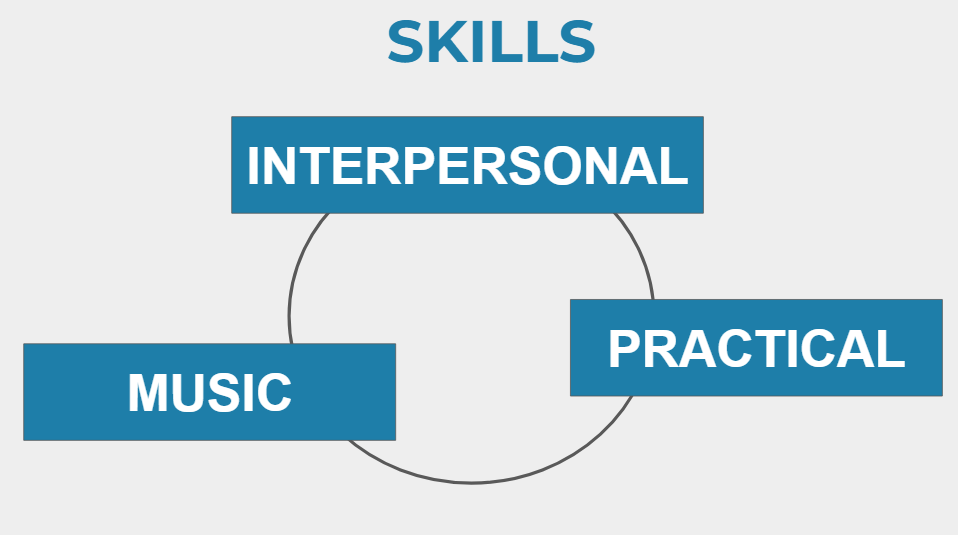
Starting or joining a band really requires three categories of skills. I drew a circle here, because they’re equally important. First, there’s music. You’re going to be making music together, and you need a certain base layer of musical skill to even join a band. But equally important are interpersonal skills. And then there’s the practical side. So we’ll go over all three categories.
Expectation Management
As I said earlier, the most important thing is managing expectations. It means that not only at the beginning, but regularly, you should hear everyone. You should create a safe space where people can share what they think and how they feel — and do it in a timely way, not when it’s already too late. Not just once, in the beginning, but continuously, as the band evolves.
Because you will get better. Your tastes may change. You’ll get better. Your situation may change. You may want to do something else. Maybe you started with covers and then moved into more original work. Maybe you want to explore other genres. That’s why you need to create a safe space for…
To make a band work, everybody needs to be able to discuss important topics. Sometimes those conversations happen directly with one person, sometimes with someone else, and ideally within the whole group. What matters is that everyone has been heard. Always ask yourself: have we listened to every voice in this band? The larger the group, the harder this becomes. More timid members may retreat to the background during lively debates, while others—like me—may enjoy discussing, debating, or even philosophizing about the band’s direction. That can unintentionally push quieter voices aside. So it’s crucial to make sure every member is heard—not just once, but throughout the entire lifespan of the band. That is the most important advice I can give, and I’ll end with it as well.
Start with yourself
A lot of this starts with self-awareness. What kind of person are you? Are you timid, outspoken, bossy? How seriously do you take the music you’re making and the band you want to start? Where do you situate your ambitions? Maybe you prefer to keep the band within a clear creative box, or perhaps you like to combine diverse tastes and fuse different styles. Either way, making music together requires give-and-take. Some members will simply enjoy showing up and playing without strong opinions, while others will have a clear vision of the songs or styles they want to pursue.
The key is to be honest with yourself. It’s fine to be the kind of person who knows exactly what they want, but you must balance that with managing expectations across the group. This commitment also shapes the roles you take on within the band.
Don’t set your expectations in stone, because once other people are involved, dynamics change. Sometimes everyone wants to do everything, which means dividing and combining tasks fairly. Other times, nobody wants to handle certain responsibilities, so you’ll need to appoint someone or agree to take turns. In some cases, you might even bring in someone who isn’t a musician but still wants to be part of the project—someone who enjoys helping out as a manager, for example. Many bands operate successfully this way, proving that roles can be flexible as long as the commitment is shared.
Your role in a band
So, which roles will you take on within the band? Think about this in three categories. First, will you simply play the parts assigned to you? Maybe you’re joining an existing band where your commitment is straightforward: you do your part, play what’s asked of you, and that’s it. Or will you go a step further by giving feedback—pointing out when something doesn’t work, suggesting more energy here, or pushing for a different approach there? On a deeper level, you might co-write or reshape songs in progress. From there, commitment can go even further: writing your own parts for originals, creating lead lines, building riffs and hooks, or even providing full song structures for the band to work with.
Ask yourself: what are you already good at? You don’t need to master everything to start a band. The real question is not just what can I do now, but what do I want to do, and where do I want to grow? Ideally, your band will live for years, giving you time to evolve. Much of your practice will naturally align with the band’s needs, and that shared goal is a powerful motivator. I always love it when students reveal—even cautiously—that they dream of joining a band. Playing with others can feel daunting or even scary at first, but if you have the skills, don’t let self-doubt hold you back.
Beyond musicianship, there are practical roles to consider. Are you the one who finds rehearsal spaces, organizes meetups, manages communication, or even books gigs? Do you bring technical or creative skills like making logos, band art, websites, or handling social media? These contributions matter. When you start talking to potential bandmates—“maybe we should form a band, I can do this and that”—it’s crucial to know what you bring to the table. The same applies if you’re putting yourself out there online with posts or flyers. Clear communication about your strengths helps manage expectations: people need to know not only what you’re looking for but also what you can offer.
Finally, there’s the interpersonal role, which is just as important as the musical and practical ones. How you interact, support, and balance with others will shape the long-term health and success of the band.
Will you initiate the “The awkward yet necessary talk“?
At some point, tension will inevitably arise—about a song, the way you work together, the band’s vibe, or even its genre. Someone needs to sense this and take the initiative to start a conversation. Maybe that person is you. No one is officially assigned this role, which is why interpersonal skills are important for everyone. But if you feel the tension and realize something needs to be said, don’t wait. Address it. Yes, it may feel awkward at first, and yes, you might need to step outside your comfort zone. But over time, you’ll get used to it, and your bandmates will appreciate it. People want to feel heard and noticed, and they’ll gladly share what’s on their mind when the space is opened for them.
Perhaps you are also the person with the widest social network—not just online, but in real life. You may be the one people naturally turn to when questions about gigs, opportunities, or connections come up. In that case, you become the social hub of the band. Skills like this often fall under leadership. You may not like the label “leader,” but leadership isn’t a title—it’s something you do. Sometimes you might be seen as the owner of the concept, but leadership can also be more subtle: simply taking initiative when the group would otherwise stall. While it’s possible to try to keep everything perfectly equal and anonymous, in practice, that often leads to slow progress. At certain moments, someone needs to step forward.
Join an existing band or start a new one?
If you’re looking for an existing band to join, start by looking in familiar places: social media, music schools, flyers, or simply asking around among the musicians you know. Have a short, clear description of yourself ready—a text you can share online, in a document, or even on a simple webpage. That way, your name and skills can be passed around within people’s networks, and opportunities will eventually circle back to you.
When joining, remember that you’re stepping into a group dynamic that already exists. On the surface, the band might show you their repertoire, Spotify account, or gig schedule. But beneath that—the “80% of the iceberg under the water”—is the complex web of personalities, expectations, and dynamics. That’s why it’s crucial to meet the band members before committing. A rehearsal invitation might come with pressure to play along right away, but don’t rush in. First, check if there’s a click, if the vibe is right. If expectations don’t align, it’s better to walk away early than waste months on a setup that won’t last.
Starting a new band, on the other hand, gives you full freedom—but it also makes you the default leader until you delegate tasks. You’ll be the one driving everything: shaping the concept, organizing rehearsals, setting direction. That freedom comes with responsibility. You can pursue the ideas you’re most passionate about, but you’ll also need to think about whether your concept is viable and marketable. A fun idea in your head may not connect with a wider audience unless you make sure you’re reaching the right people.
Start small
The advice I usually give is to start small. You can always begin solo, then move into a duo, and beyond that, into a band. From three people onward, you can call it a band, but working as a duo is often the best next step. It’s usually easier to find one person who’s on a similar level—or someone more advanced, or even less developed but motivated to grow together. A duo gives you plenty of creative space while keeping things manageable.
Today, it’s easier than ever to collaborate in this way. With online calls, shared documents, and digital tools, you can write, arrange, and even produce songs together remotely. Some musicians are already doing this successfully: duos and bands from different parts of the world have built catalogs, developed a clear image, released songs, and established their own style—without ever playing in the same room. So don’t limit your idea of a “real band” to the traditional stage setup. Promoting and sharing your music online is just as valid.
Working in a duo also makes you more accountable. You keep each other motivated, promises get followed up on, and progress comes faster. That collaboration often leads naturally to growth. For example, if you’re a guitarist and a singer, once you have a drummer, you can start performing live. And since drummers are among the most in-demand musicians—many play in several bands—it’s much easier to attract one if you already have something to show. Share your songs, demonstrate arrangements with programmed drums, and present a vision for what the band could become. That makes your project appealing and credible.
In this way, a duo becomes both a realistic short-term goal and a stepping stone. Finding just one kindred spirit allows you to combine skills, practice give-and-take, and build a foundation that can naturally grow into a full band when the time is right.
When am I good enough to join a band?
That is one of the most crucial questions people will ask themselves. The mentality might be there, but what do I need to be able to do to actually join a band? Based on whether are you starting with a duo or as a full band, your tasks might differ and and what about the practical things I tried to compose some kind of primer, a set of fundamentals for some roles in the band that I think you should be able to grasp to to be able to to perform
Rhythm Guitar
One of the easiest ways into a band is through rhythm guitar. Not because it’s “easier,” but because learning the rhythm parts of a repertoire is often more straightforward than taking on every solo. If you’re a strong technical player who can learn solos quickly, that path may suit you. But for most, rhythm guitar provides the best entry point.
Here are the fundamentals every rhythm guitarist should aim for:
- Play with a drum track: Practice with various sources—drum tracks, backing tracks, and metronomes. Your goal is to stay in time without getting lost. If a drummer counts in and starts playing, you should feel confident following along. Learn to anticipate fills, which signal transitions between song sections.
- Strumming patterns: Master solid up- and down-strumming at least at 80 BPM. This builds the foundation for classic rock and beyond.
- Chord sheets and transposition: Be able to play from a chord sheet, even if the song is in a different key than you’re used to. Ideally, you can transpose quickly during rehearsal to fit the singer’s range.
- Playing without looking: Avoid relying on the fretboard too much. Freeing up your attention lets you focus on the song’s structure, the vibe, or even singing while playing.
- Song structure awareness: Learn to recognize verses, choruses, and bridges by ear. Cover bands often shorten or rearrange songs, and medleys require quick adaptation.
- Adapting to the drummer: On stage, the drummer is the boss of time. If they speed up, slow down, or miss a beat, you need to adapt instantly instead of sticking rigidly to your own pattern.
- Essential chords: Know at least one major and minor shape for every key (A, B, C, D, E, F, G). Ideally, also learn 7ths and minor 7ths for greater flexibility.
- Practical skills: You should be able to change a broken string during rehearsal, solve basic gear issues, and transpose on paper quickly.
With these skills, you’ll be well-prepared to start in a duo or join a band confidently.
Lead Guitar
A lead guitarist needs all the rhythm guitarist’s skills—and more. Your role is to add melodic flavor, riffs, and solos that give the band its identity.
Key abilities for a lead guitarist include:
- Scales: Be proficient in at least one major and one minor scale shape. Scales help you improvise and recognize recurring note patterns when learning songs.
- Timing and awareness: Know exactly when your part starts and stops. Nothing is more awkward than continuing a solo while the rest of the band has moved on.
- Playing in the band’s style: Adapt your playing to the genre and vibe of the group.
- Transcribing by ear: Often, tabs or sheet music won’t be available. You’ll need to figure out existing material yourself. Recognizing scale shapes can speed up this process dramatically.
- Skill development: Lead guitar often requires more time to build speed, ear training, and precision. That said, you don’t need to be a virtuoso to join a band. Many groups consist of players learning together. A band can be the perfect motivator to grow these skills.
One word of caution: don’t exaggerate your abilities when joining a band. If you misrepresent your skills and can’t deliver, you’ll create tension later. Be honest about where you are, and choose a band whose level and goals match your own.
Singer
Singers can either stand alone or combine their role with rhythm or lead guitar. Either way, certain skills are crucial:
- Transposition: Be able to adapt songs to your vocal range. This may mean rewriting chord sheets or working with bandmates to shift keys.
- Singing with a backing track: In plain terms, your karaoke skills should be solid. This means keeping pitch, timing, and structure while singing with accompaniment.
- Singing from sheets: When a band is learning covers, papers will often be involved. You need to know when to start, when to stop, and how to follow the structure without confusion.
- Learning material: Just like guitarists, singers must learn existing songs accurately. Later, when the band moves toward originals, you’ll also need to know how to shape melodies and lyrics over the music.
A singer’s role is unique because the band will often adjust to fit your optimal range. But this flexibility means you carry responsibility: come prepared, know your parts, and be ready to lead the group musically when needed.
TO PROCESS *********************************************************
two ways to approach this uh in a synchronous and an an asynchronous manner. I already briefly touched that in the beginning especially in today’s age um we have the tools to do both. We have the tools to get together and write together in the moment but also to develop our own parts and bring them together uh online and share them and and check them and work on them in their own time when it when it works for us. So what does that mean? Um when you’re doing a synchronous session, uh example,
you decide you put on the agenda of the band. We will be uh doing the set first and then we will write song. You’re all together. Uh you’re all committed. You got your instrument there. Um you’re all there in the same time and you work on a song there. best is that you already have something to bring to the rehearsal, some some ideas that you recorded at home and you demo and say, “Can we do something with this riff? What about this structure? Look, I got this melody. Uh, this could be a hook.
This could be a verse.” If there’s absolutely nothing, it’s hard to get that kick started. If you got a really creative band member who comes up with with licks and hooks or a drummer who says, “Okay, let’s jam along on this one.” Okay, you decide on a key and you start jamming. Um, it’s all cool and it happens on TV a lot, but not so much in in in bands, especially if they’re if it if they’re not uh all professional musicians. But the pro things is you got you got
all the communication, you got the non-verbal communication as well. You you immediately see how’s the drummer going into it. you you notice on the basis how he looks and and and his posture that he’s not really getting it already. Stuff like that. You you don’t get that at home. You only get that there in the session. And that also means that can be quick in feedback. Oh, that that was a cool idea. And um this is something we do with the band a lot. We prepare some stuff at home. Uh we
come up with some licks with some ideas. We bring them to rehearsal. Um, I usually show them to our lead guitarist. He alsoifies it. He he makes he’s a lot better player than I am. Um, but he has a certain style um of playing a lot of notes and then I’m then I’m the guy to say keep keep out that note. Let’s let’s put some emphasis here. Let’s let’s put some silence there. And you’re quick with the feedback. Oh, that sounded good. That went well. M. Let’s try this. Try differently. Oh, I
got an idea. How about this? Oh, yes. It goes really, really fast. When you’re together in the moment, you can quickly optimize uh uh you can quickly optimize a certain hook, a certain lick or solo or something. Of course, there’s the inspiration risk. As I said, if there’s nothing on the table yet, there’s no agenda, there’s no material to work with, to be inspired by, then such jams could fall flat completely. And also, it’s expensive time. By this I mean you don’t have so much time together. You
should spend it well. And also, uh it’s l literally expensive because you all paid for the venue, uh the rehearsal space, um and you paid gas to get there. Um so there’s a certain commitment and it’s valuable time. So make sure that you have an agenda for each session. Um bringing an agenda will also give you some authority in your band. You will be the one looked at the facto as oh this this person is arranging all these things. That means they will also look at you. You’ll have more work but you
got more agency and what happens with the band the direction what we will be doing where is the focus and depending on what you bring and the feedback that happens you can also decide what material is being worked with. So it’s two sides of the metal there. Then there’s the asynchronous part, the part where you use online media, shared fold folders to to drop sound files, to to record riff ideas, to write some lyrics, to um get a sheet with song structure together. Um, it can be very efficient to pingpong
ideas, but when everybody can work in the time that works for them and they can focus on what they’re doing and there’s also no stress of the moment, they can take their time and and and have it ferment in their mind a bit. Um, but there’s also the risk of less involvement. you will often have um some band members committing less than others and that’s normal. Um it has it its upsides as well because it it’s usually faster to develop an idea with two than with three or four. So try
to find a balance. If you notice that people aren’t really committing to that, make sure to include them, asking feedback, actively making something, showing it to them, asking, “Okay, what do you think of this? What do you think of the groove? What do you think? Is it long? What do you think of the vibe?” Stuff like that. Really questions they they can just say, “Oh, it’s good.” But you dig a little deeper. So as I said when it comes to playing in a band managing expectations is that’s
just key. Uh also for the roles um be clear on the roles be explicit on the roles and by this I mean which role will you have in this particular song. Um you will do rhythm guitar and you’ll sing. Um we um you said you wanted to play the the the little bridge thing. Okay. Can you come up with that by next week? Okay. Uh a specific question asking can you can can you come up with this bridge part by next week is specific. You’re managing expectations here. It’s not one day. It’s not that thing we talked
about. No, be specific. And in best cases, even write these things down uh kind of to-do list. Uh you you’ll have to find a way that that works for everybody. Some people can be, “What’s with all this red tape and stuff like that?” Other bands like to have that tidy and knowing, okay, we got some ideas and we make sure we capture them and we don’t want to forget them. Um, ice cream truck coming by. Not sure if you can hear that. Also, create some safe space to discuss all these things. Um, you want people to
talk out as reflex. uh as a nature um in the best case they come up with feedback about all these things themselves otherwise you’ll need to go ask it um and if there are changes to typical roles be very specific about it ask it propose it um if it is it okay that I try to write solo for this song yeah okay it is about two bars okay I will write something and show it to you uh and we can both improve it. Okay. Managing expectations. It’s better to ask more and in more detail than you initially think. Um
nobody knows what you’re thinking and with more in the band um the more specific questions the bigger the chance somebody will get involved as well. Also try to optimize your workflows. Um you’ll notice when you start to create songs in a band that in the beginning it will take a lot of time, a lot of effort, a lot of things that need to be done again and again. Um but at a certain point you will find uh some go-to um settings in your software, some go-to structures for your songs, some
goto uh vibes, whatever. try to acknowledge them in a band. Really acknowledging them, saying, “Look, this song, these things in this song, they really define what our sound is, what our style is, what our vibe is that we bring.” Um, I like that and I’d like to see that in upcoming songs as well. I’m being very explicit here and I I don’t think that a lot of people do it that way, but um I keep that in mind every time we create a song. And now we’re at a stage where we
have um our lead guitarist has presets for his guitar. I have presets for my vocals. Um we we even have a certain way of recording it. I go to his place on day on the on Tuesdays. We don’t have a rehearsal and that’s when we do recordings and we do the recordings like I’m at the microphone, he’s at the at his Mac uh pressing the buttons doing all the takes and it goes so much faster if you can do this with two people. And you need to find out what are the workflows are is a workflow that a lead
guitarist creates uh few versions of a solo, puts them online in a folder and then you decide as a band which one you like most. Do that every time. If that works, do it again because you create uh an expectation of this is a pattern that we’re working. Do you need to do every song the same way? No. No, you need to vary as well. Um, I’ll get to that later. Um, start start with creating a lot. Don’t try to create a masterpiece from your first song. As in the uh in the session about the lyrics and the
songwriting as well. Uh, create some first. Uh, focus on quantity first. This uh focus on quantity. Uh, creating some shitty songs. uh make them fun and and you’ll notice that song that you never thought that would be that would be so great is actually one of your favorites. Uh you can put some money on that. But creating songs more and more will optimize your workflow will they will ask less energy of you each time. And by the time you’re really getting into that and your your songwriting muscles are are really
getting developed, you’ll put a lot less energy and the frustration and the drag that comes with an unoptimized workflow. So don’t try to write your masterpiece in the for the first song because it won’t happen and it will the waste will be the waste of a lot of energy. Also make use of tech. Um, that’s also important when uh going over the roles in the band. It’s also in the checklist that I put out. Um, figure out what people what gear they have access to and what skills do they have besides a
rehearsal room. Um, our drummer knows how to program his drums in a mighty file, a MIDI file, which is very, very convenient when you don’t want to go to a studio to record drums and just a lot of time and money to do that. Um, but the drum will sound like him and with a few tricks like uh humanizing it and stuff like that. You will get to a drum that really gets close to how he drums it because he decides every hit, but that’s because we know that he can program these medi drums. Um, is there
somebody who knows a bit of recording? Is there somebody who can do some mixing? Is there somebody who know that you can do that outside of the band? So try to map your workflow on these skills as well. Of course, share your your files. Um set up shared locations. Make sure everybody can access them. Agree on the platform. You can decide on a certain platform, but if somebody doesn’t like working there, that person won’t check it and won’t participate in the process, and it will be hard to to involve them in your
process. So make sure that from the beginning you are sure that everybody is convinced that yeah this is a good platform to work on to put our files and they will do that. Um as just said um that doesn’t mean that every song needs to follow the same workflow. Um it’s good for variation in in your songs that you try different starting points. starting point. A riff could be a starting point to a hook through the song, a certain verse. It could be the the melody of the verse. It could be uh the hook that makes up the
chorus. It could be a lot of things. It could be a vocal melody that somebody comes up under the shower and and comes out of the shower and records it on a cell phone and and and send it and it can be the inspiration to a lot of different things. Oh, what kind of chords would fit under this? So, what kind of groove was I imagining? Oh, it was something completely different than I had in mind, but this is actually pretty cool. And then you’re using different inputs of the band. And everybody feels, oh, I’m being listened
to. I’m doing my contribution. What I do is part of what the band produces. And commitment will follow and loyalty will follow in that in that order. the more you can create yourself. What kind of role you take up doesn’t mean that you will need to do all all these things. If you can find a way that some people decide the direction but everybody’s committed to to bring effort to the band, then you could be very efficient in in the creation of songs and and getting a brand up and getting
promotion out and stuff like that. Could be that you recycle an old project, of course. So, an unknown user asks, “As a beginner, still weak in my guitar, but a strong vocalist, how can I find a band to be part of?” And that’s a good question. Uh because if in this case specific, if you are a singer, but not so much a guitarist yet, profile yourself as a singer. put yourself in the market as a singer, but um also list what you’re currently working on. So, it’s clear that I’m currently
this, but I’m growing as that and my ambition is to go there and I would like to do these things and I like these genres and it’s pretty broad, but or it’s pretty narrow. So, try to be complete in that. So, um perhaps aiming for a duo to start here is great as well. uh if you’re confident, you can drop into another band. But once again, don’t don’t overstate uh your skills. Be honest in that. Um there will always be room for you to take up certain things uh with your guitar. When you’re confident in the
groove of the band, do you it fits? I know what to ask. I I felt these guys or girls they I can ask things in this fashion so I can propose things in these fashions and so you can gladly shape your job in these b in the this kind of band as you go but you should always profile what you are and not what you’re not so managing expectations being complete in what your expectations are what do you have to offer what are you looking for good balance of those two it’s give and take also how flexible do
you want to be the more flexible you want to be, the more jobs you can get that way. That speaks for itself. And that’s why I said, show your worth and your work. Um, so if you can show some stuff that you did, even though if you’re a singer, create some recordings of you singing over uh over backing track, uh, stuff like that. Um, people should be, if you’re a singer, should be able to to see a demo of what you’re capable of. Um, and if you’re decent singer and and you can throw in one recording where you’re
also playing guitar or something, then they know. Um, but writing it is just enough. If you feel very stressed and unconfident to to throw in the guitar part already, keep it out. Profile yourself as a singer, but say that you’re growing as a guitarist. So, find the needs online and offline. Uh, spread the offer, the social network. once again create that personal network. Uh then of course jam sessions are are are a great way as well. But it all dep it’s very it all depends on on where you are
in the world and what your situation is and how much time you have and and what kind of band are you joining here. Um it’s it’s hard to to say these are things you want to do because there’s no magical formula. But managing the expectations, being honest, showing what you’re worth and uh what you are and what you’re becoming will help. I see a lot of people asking to join a band. I’m looking for a band uh or we’re starting a new band and we’re looking for this. And then they they leave out a lot of
that crucial information. And I I even if if I would be looking for a job, I I wouldn’t be triggered to react because they they didn’t warm me up. the the more points are there this fits me this fits me this is okay I can live with this and the more information you give the bigger the trust becomes and the easier it is for people to say oh this this I don’t know but all the other things are okay so they will say okay they they will mostly remember the good things people will mostly remember the
good things so Mr. Brian Larson from our community. Um, he asked how to deal with B band members who have different ideas. This will happen in every band. I’m sure at a certain point you will you will start at a certain point. Uh, you you do the talk, you manage expectations, you align all the ambitions, but your band evolves. And some people want to do heavier stuff or some people wants to do some more exotic or some more fusion stuff. They want to make it swing your jazz. You’re whatever. It doesn’t
matter. Um there was an initial view of the band and some ideas and expectations are no longer aligned. The awkward talk needs to happen. Um the more you cycle this expectation management in your band, the more they’re used to it and the least likely it is going to happen. or if it happened, it it won’t be that severe if if it’s a long time ago and there’s a lot of tension going on and you know, nobody’s in the mood to address the elephant in the room, but it’s actually going to happen, then it will be a lot a
lot to deal with. A band potentially splitting stuff like that. So doing a doing a lot of checks and being explicit and creating this safe environment will help and will keep this fringe small. Um but when it’s necessary, somebody needs to facilitate the talk. Uh and it’s up to you how awkward that that is. Um but if there’s already a culture that stimulates feedback and where it comes naturally, it won’t be that awkward at all. It will be much appreciated that uh opinions are stated
and that will show that it’s a safe environment to do so. But you need to find the common ambition again. What is that? Can we define this as a band? What is the ambition of everybody? What is the common denominator? Do uh are there ambitions that are far out there or they all close together? Okay. Can we find peace in that? Yes or no? Uh same for genre, same for roles that we are doing. Um perhaps some family situations changed and and and somebody can have the same commitment again. Perhaps
somebody is joining a second band. Um which you need to decide does that fit our policy or not? That all depends our ambitions you are or how much you you kind of lend it to people that they they have a different kind of egg they need to get rid of in another band, different thing that they can do there. So they have that other kind of energy for your band. It all depends. And clear the scope. Draw the lines of the this is this is the the issue that needs to be talked about. This is what the band is about.
This is our goal. This is why we do this. Uh be very explicit about that. You’ll have to be brave. Um yeah, if you need to initiate a stock, you need to be brave, but be patient with others. Um, as said in the beginning, some are more more directive, some are more direct, some are more timid. Um, you need to hopefully you communicated with all band members enough to to feel how to approach them. Um but you need to be patient and um you’ll need to create some kind of culture where everybody knows that some
sacrifice will be necessary to realign the band. If you want to keep playing together uh and keep having fun, some sacrifice is needed somewhere and where will it be? In best case, everybody sacrifices just a little bit in their principles and then you’ll find that middle again and then it will create more unity because everybody knows we all gave a little and we all took a little but in some cases that won’t be necessary and then um it it won’t in some cases it it won’t help. Uh and then perhaps even a split is the
best thing to happen to uh convince to ensure the happiness of both the person or people splitting uh and the future of the band as a concept uh or these people playing together. And um for your network, these people won’t disappear out of your network. So, it’s best to to split in on best terms and and to to be able to do all of your things but in different bands. But perhaps because now you’re separate bands, you can have uh cooperation, do gigs together. Uh oh, we can play but these guys can play. And it
doesn’t mean that you need to become enemies. Um but creating the safe space for feedback is what one will prevent these kind of situations and two uh will facilitate the situation when it happens um in a real explicit manner. If you have people who who want to do their own thing, um if that strongly differs of what was already already set up and agreed, then you it also needs to be possible to confront them with that. Um so the balance between between sacrifice and confrontation, yeah, that’s all down to
what kind of people are these and how strong are all those social skills to work with. So that’s hard to predict. The bottom line is managing expectations. Once again, um the most explicit way is to put everybody together and go over all these things like you were starting a new band. If we if we want to continue today, what do you want to do? Does that differ a lot from what we were already doing or not? Okay. So what are those things? Do you notice there’s a lot of difference? Then you have to go over all these
things again and be very very clear about them. Okay. I think the last question um was how can we write feelings in our songs without uh making cringy words and and and and stereotypical things. It’s a good question, but it’s a bit bit off topic because it was more it was more something for the songwriting and the lyric session, but I’ll be brief in this. Um, main advice one, be implicit. So, I talked a whole session about being explicit about things. When it comes to lyrics, be implicit, be indirect.
Instead of saying, “I feel so alone without you,” you need to have listeners come to that conclusion, not by saying them, saying it to them, but showing them somehow in an indirect fashion. I take my bad decisions all on my own now, which means I have nobody to stop me, which means I have nobody to ask advice to. I have nobody to better my life. That means that I’m alone. And that means oh um there’s nobody else in my life right now. I could be lonely. I could be something else. So that’s an
implicit way of saying that. You can also use very trivial observations. Um instead of it hurts that you are not here, you can say well I was kind of doozing off and I I was staring just mindlessly in front of me and I saw the old jackets on on the hangers. I counted them. There were 12. They were all mine. What does that mean? If all the jackets on the hangers are yours, that means there’s nobody else in the house and there’s nobody else there. So once again, it’s very indirect way to
get people thinking, “Oh, oh, he’s he’s distracted. He’s he’s he’s he’s pondering and and definitely all the clothes that are there are his.” Also, write in your voice. Uh write in in a way that you would speak to a friend in a chat. uh just like I’m talking right now. So don’t say the damn nation with his dissident of romance. You don’t say that in daily language. I I’d say the hell to all these cheaters. I’m blaming all the fakers. That really sounds convincing. Um I
think when when I wrote this, I I thought of uh the the singer Pink does that really well. Um really everybody understands what she’s saying. It’s very clear. It’s very simple. Uh it’s not to be misunderstood. It’s very conversational. So try to be conversational as if you were talking to somebody else. And then take the extra steps. Go associating. Uh check the check the stuff uh that session about the songwriting about the lyrics writing there. Uh I do this exercise as well.
Instead of saying you make me speechless, what does it mean speechless? the ability, the inability to speak. I can no longer speak. How how does that how does that translating something you can you can see, you can feel, you can hear instead of just being told, “Oh, um I was in the middle of a story and and and I get I I get lost because I’m literally a figuratively speechless. I broke down in the middle of my story. What does that mean? Does it mean that I wandered off, that I started worrying, or that I I just can’t
speak? Well, that’s all to the listener to decide. So that means be indirect, keep it simple, keep it conversational right as you speak to a friend. Associate further on what do these things mean? Don’t tell people, but show them. Don’t tell them I’m lonely, but show them in something that happened to you today or something that you imagine somebody like you would be doing. All right. So um once again to wrap up this session because it’s always going so fast I will share the links one more time. The
checklist should be still under this key like this. Yes. So that’s a list with 11 items for you to check when you want to start a new band or perhaps joining an existing one. But it’s mostly focused on starting a new band, a checklist going from um what do I need for roles, but also um what are the practical things, where are we going in the future? And then there’s this link. It is the slide deck of that I used um in most of the show today. Um I’m going to briefly check for some questions here.
Let’s see. group that there seems to be an excellent series about the tragically hip. Um, that is an excellent recommendation. We should check that out. Uh, it seems to be about how a a band works, about the internal mechanics of a band. Um, let’s try to to dig that up later. Sounds very interesting. Keep in mind that playing successfully in a band is not for everybody. Yes, I don’t blame you if you don’t want to play in a band. I just think that it’s a great way to be motivated and it’s real
fun to play together and it’s real um rewarding to be on the stage and delivering what you made. But it can be daunting to many. And that’s why I always I also make these sessions about um building confidence, building your story, building your repertoire, how to bring that to a show, how to go from bedroom to stage. All these topics that I do sessions on are about um people who kind of dream they they think it’s a distant dream to be on a stage one day but but but think that they are being kept
by themselves by factors by fears by stress by practical things by the skills. Uh I want to I want to empower them to take steps to to go there if they want to do that. If you play music just to be in your room and to relax and lose yourself in the music, that is just as good as a motivation and a reason to play music. Absolutely. Any tips on how to find others in my location that are starting a band? Well, as said, there’s no there’s no magic list of things to do. Uh it all depends on what kind of region you are. Is it is
it rural? Is it is it residential? Is it is it a city? Um are there venues close by? Are there social media that you can use? Um in extreme cases, know that um you can actually create Facebook ads that would only cost you a few dollars and where you can work very locally. Um these days it’s it’s more now but it used to be only a few miles but I think now it’s about 10 miles 17 kilometers um of range where you want your ad to be shown and you can you can select interests uh what people do. So, the
chances are that they are involved with something with music um are are higher and you you could create an ad um with a few clicks to show in that region that says um singer looking for a band uh and then referring to some page you put on somewhere. Know that Google sites gives you a free way to set up a website with an easy editor. The link is not that beautiful that it creates, but it’s very easy to create some content online. Put a bit little bit of resume on it or a Google document that you share. Make sure that you don’t
give edit rights to everybody, but just create a link for everybody to view. Put all the info that I talked about in there today and link it in this in this ad. Or create some flyers that you drop off in uh some music stores, in some music schools. try to figure out who in your network is doing all these things. Uh perhaps give them some of the flyers or give them some uh the link. You you’ll need to figure out what what the connections are. Building that network will bring the answers on how to promote
uh naturally. If you build the network, the rest will come. Um there’s no secret formula to do that. starting to build a network in order to use to distribute your questions or to gather. You have a you have a need and you want to gather people, you’ll use the same network and as soon as you start building it and you see what these people are doing, they will also expose you to their needs and their requirements and perhaps you can pick up on them. So building the network itself will answer these questions. You
just need to keep your eyes and your ears open. Okay. Um I can do backup singing. Okay. But lead singing. Um not sure what. So you’re okay with backup singing, but lead singing not so much. Um, I think that’s mostly down to being the solo singer on some things you record yourself and putting out there. Um, and also perhaps some stage fright, some stress and stuff like that. You’ll need to pinpoint what the factors are that uh that made that up because I think it’s harder to be a backup singer than a lead
singer. That might sound odd to you, but um I think much to do has to do with the control that you have and the role that you have. Okay. Let’s see. Okay. I think that is all there is for today. also for the questions. If there are still questions about this topic, um there’s so much I could tell you and I’m always going over time. Um I’m sorry for that, but I’m just that enthusiastic to spill everything I I want I know that I want to share with all you guys. Um you can ask on the community
uh or just email me which is leveng guitar.com. Um, you can find my information on justing guitar website just as well. Uh, I’m pretty sure you can find me somewhere. Uh, and feel free to ask. Um, I also do uh coaching and teaching online especially for people looking for what are my goals? How am I going from here to there? Um, what do I need to learn next? I want to develop this. I want to express myself. Um, if that interests you, you’re of course welcome to contact me as well. And um we’ll we’ll do a brief free intro
call just to see if there’s a match. Do can I need to check am I the right person for you to coach you and you need to check do I have a good vibe with what Le wants to do with the goals that I have. So if you want to meet up to perhaps later on get into some sessions. I have no fixed formulas. all is custom custom based on what this coach needs. Uh, and if you want to figure out what that could be for you, just drop me a mail. We’ll do a brief call and see is it a match. Can we get a a show on the
road or not? We’ll see. If we don’t, friends just as well. Okay. Thank you guys. See you next time. Check the justinguitar.com/clubs page for to see where the next session is. I think the October session isn’t on the site yet. I’m sorry. Uh there’s already a November session for the motivation club, but I think the October one still needs to appear and the topic is still a surprise as well. Um we’re still deciding that. Okay, see you later, guys. It has been a pleasure and
I see you around. Bye-bye.